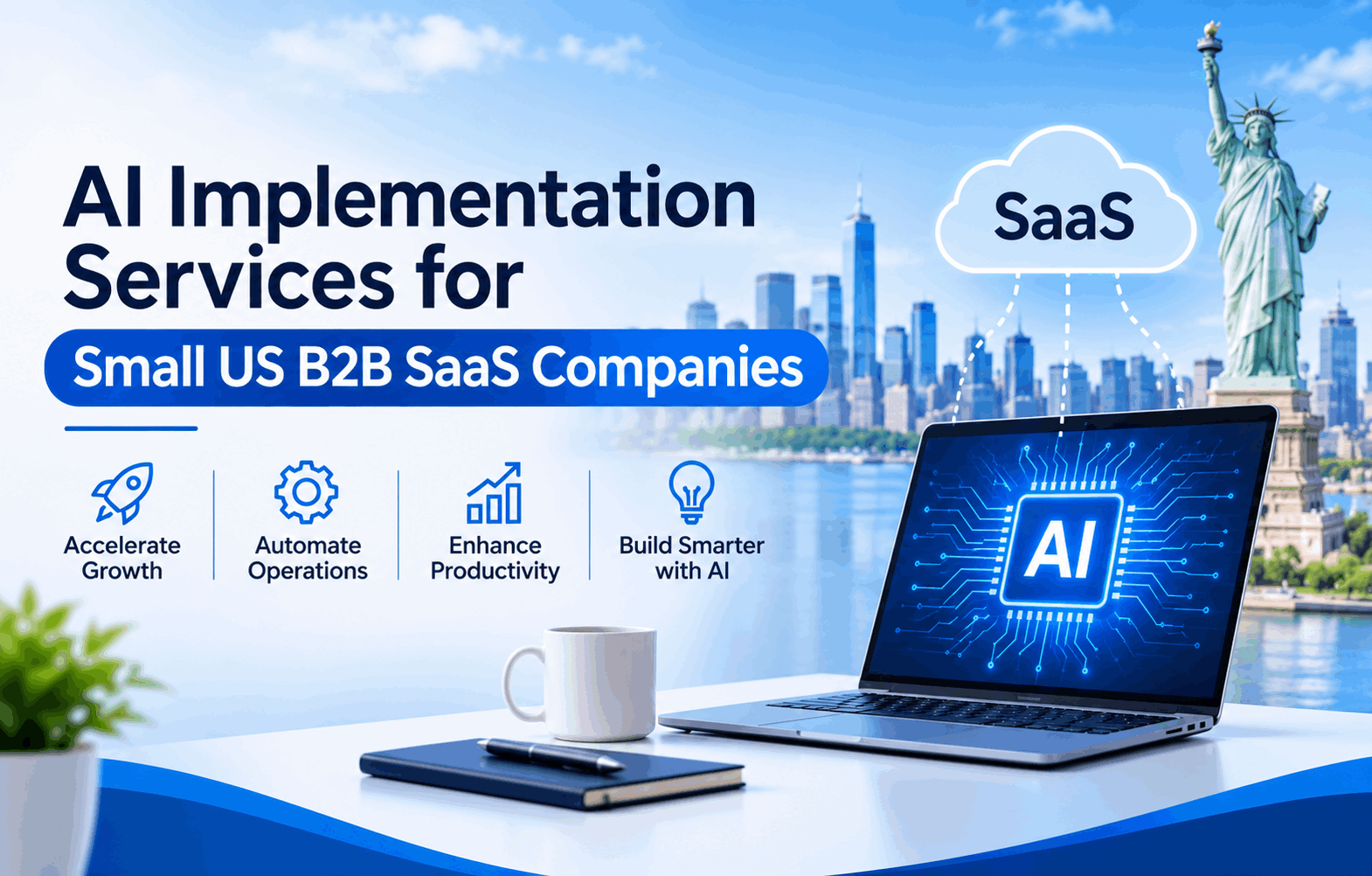
Small B2B SaaS companies in the United States face increasing pressure to improve productivity, deliver better customer experiences, and compete with larger software businesses. However, limited engineering resources, operational expenses, and growing customer expectations can make these goals difficult to achieve.
Artificial intelligence offers practical ways to address these challenges. From automating customer support to improving sales operations and introducing intelligent features into software products, AI can make everyday business processes more efficient.
For companies exploring us b2b small size companies saas software ai implementation services, the real objective should be more than adopting new technology. It should be implementing AI solutions that solve specific business problems, integrate with existing systems, and deliver measurable results.
Why Small B2B SaaS Companies Are Investing in AI
Unlike large enterprises, smaller SaaS businesses usually operate with compact teams and limited development budgets. Their employees often manage multiple responsibilities, making repetitive tasks a significant operational challenge.
AI implementation can address these limitations in several ways.
- Automating Repetitive Operations
AI-powered automation can handle routine activities such as organizing customer requests, processing documents, generating reports, and updating business records. This reduces manual work and allows employees to focus on more important responsibilities.
- Improving Customer Support
AI-powered support assistants can understand customer questions, retrieve relevant information, and suggest appropriate responses. They can also categorize support tickets and direct complex issues to human representatives.
- Making Better Business Decisions
AI analytics can examine sales records, customer behavior, and operational data to identify patterns. SaaS companies can use these insights to understand customer requirements, identify potential problems, and improve business planning.
- Developing Smarter SaaS Products
Companies can introduce AI-powered search, recommendation systems, intelligent reporting, and automated workflows into their existing software products. These capabilities can improve product usability and create additional value for customers.
AI Implementation Services for Small US B2B SaaS Businesses
Choosing AI software is only one part of the process. Businesses also need technical expertise to integrate these technologies into their existing infrastructure.
The most useful us b2b companies small size saas software ai services generally focus on the following implementation areas.
- Custom AI Software Development
Every SaaS business has different product requirements and operational workflows. Ready-made AI platforms may not support every business requirement.
Custom AI development allows companies to build applications around their specific needs. Examples include intelligent customer support platforms, AI-powered document processing, predictive analytics, and automated business applications.
Explore CloudStakes AI software development solutions to understand how custom AI applications can support business operations.
- AI Integration With Existing SaaS Platforms
Many small companies already use CRM platforms, customer support applications, databases, and project management software.
AI integration connects intelligent capabilities with these existing systems. For example, an AI assistant can retrieve customer information from a CRM, summarize previous interactions, and suggest the next action for a sales representative.
Proper integration reduces disconnected workflows and makes AI more useful across different departments.
- Generative AI and Intelligent Assistants
Generative AI can help SaaS companies create intelligent assistants that understand user requests and generate relevant responses.
Businesses can use these systems for knowledge management, customer support, internal documentation, and product-based assistance.
For more advanced automation requirements, explore Agentic AI development services.
- AI-Powered Workflow Automation
Workflow automation connects multiple business activities into a coordinated process.
For example, when a new customer submits a request, an automated workflow can categorize the inquiry, retrieve relevant information, create a support ticket, and notify the appropriate team member.
This approach is particularly valuable for small businesses that cannot dedicate employees to every repetitive operational task.
Common AI Implementation Challenges for Small SaaS Companies
Although AI provides several opportunities, implementation requires careful planning. Small businesses should understand the potential challenges before investing.
Data quality and availability: AI systems depend on reliable information. Incomplete, outdated, or disconnected business data can reduce the accuracy of AI-generated results.
Integration difficulties: Connecting AI applications with existing SaaS platforms can require API development, database changes, and additional technical configuration.
Data privacy and security: SaaS companies frequently manage confidential customer information. They must establish access controls, secure data processing, and appropriate information-handling policies.
Implementation costs: Software subscriptions are not the only expense. Development, customization, infrastructure, employee training, and ongoing maintenance should also be considered.
Unreliable AI responses: AI-generated information can sometimes be inaccurate. Human review, testing, and continuous monitoring are important for maintaining reliability.
How to Choose the Right AI Implementation Approach
Small B2B SaaS companies should avoid implementing multiple AI solutions simultaneously. A structured approach can reduce unnecessary expenses and technical complications.
- Identify a business problem: Select one process that consumes considerable time or creates operational difficulties.
- Evaluate existing infrastructure: Review current software, databases, APIs, and data quality before selecting an AI solution.
- Choose the right technology: Decide whether an existing AI platform, custom development, or a combination of both is suitable.
- Start with a pilot project: Test the solution with a limited workflow before introducing it across the organization.
- Measure performance: Track operational costs, processing time, customer satisfaction, and accuracy.
- Improve continuously: Monitor performance, collect employee feedback, and update the implementation as requirements change.
Companies exploring us b2b companies small size saas software ai implementation services should prioritize solutions that fit their actual operational requirements instead of investing in AI simply because competitors are adopting it.
Conclusion
AI implementation is becoming an important consideration for small B2B SaaS companies looking to improve their products and business operations. From custom AI applications and intelligent assistants to workflow automation and system integration, businesses have several opportunities to introduce AI without rebuilding their entire technology infrastructure.
The most effective approach is to begin with a clearly defined business challenge, select suitable technology, and implement it through a measurable process.
With the right development strategy and technical expertise, small SaaS businesses can build more efficient operations, improve customer experiences, and create software products that are better prepared for changing market requirements.
For businesses planning their next technology initiative, CloudStakes offers software development and AI-focused capabilities to explore according to their project requirements.
Frequently Asked Questions
- What AI services are suitable for small B2B SaaS companies?
AI-powered customer support, workflow automation, predictive analytics, intelligent assistants, and custom AI software development are practical starting points.
- How can small SaaS companies implement AI with a limited budget?
Start with one business process that requires significant manual effort. Use existing AI tools where possible and invest in custom development only when specific requirements cannot be addressed through ready-made solutions.
- Can AI integrate with existing SaaS applications?
Yes. AI solutions can connect with CRM platforms, databases, customer support systems, and other applications through APIs and suitable integration methods.
- Why are AI implementation services important for B2B businesses?
They help businesses move beyond experimenting with AI tools by handling planning, development, integration, testing, security, and deployment.
- How long does AI implementation take?
A simple AI integration may take a few weeks, while complex custom applications can require several months. The timeline depends on data readiness, technical requirements, and integration complexity.
- Is custom AI development necessary for small SaaS companies?
Not always. Existing AI platforms are suitable for common requirements, while custom development is useful when businesses need specialized functionality or deeper integration with their products.
 EdTech
 FinTech
 Logistics
 Healthcare
 Automobiles
 Manufacturing
 Telecommunications
 InformationTechnology
 About Company
 CEO's Desk
 Global Footprint
 Privacy Policy
 Terms & Conditions
 Support
 Careers
 Refferal Program